Vertical slices across the system
The editor, database views, knowledge graph, sharing, and MCP integration were developed with corresponding backend contracts. A feature was not treated as a finished UI in isolation.
Open Silong is a released, open-source workspace with an editor, databases, collaboration, and an agent-ready integration surface. The product challenge was making these capabilities share a coherent data model.
Rahman Fakhru · Product case study
A familiar editor can look complete while its databases, sharing rules, and integrations behave like separate products. Once people and agents work with the same content, the boundaries between views, permissions, and data contracts become part of the experience.
Rahman Fakhru designed and built the system described in the published project and its public source. This case study describes the released workspace and its architecture, not a client commission or a promise of uninterrupted service.
The editor, database views, knowledge graph, sharing, and MCP integration were developed with corresponding backend contracts. A feature was not treated as a finished UI in isolation.
The MCP HTTP surface exposes deliberately structured JSON for integrations and AI agents. Access and permissions remain product concerns, rather than being inferred from an agent's ability to read a page.
The public guest workspace allows exploration. A self-hosted Docker path and portable JSON, Markdown, and ZIP exports give operators a way to control where their data lives.
The released workspace includes a block editor, database views, knowledge graph, collaboration controls, public sharing, version snapshots, export, and MCP integration. The linked public project and case-study frames let readers inspect the work.
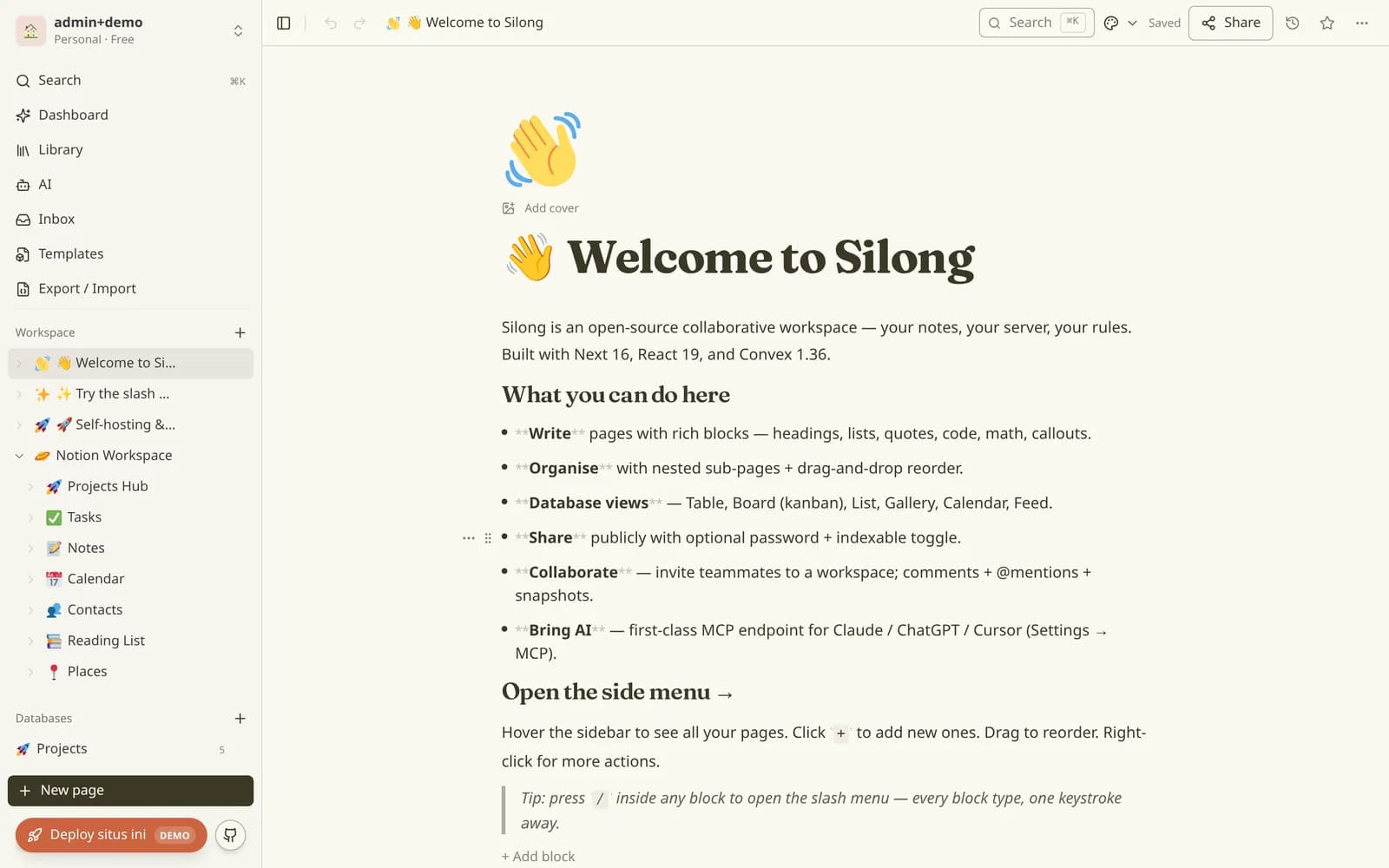
Editor — rich blocks, a slash menu, a cover, and nested content.
An integration-ready interface does not mean an agent should receive unrestricted workspace access. Deployment and data responsibilities differ between the public demo and a self-hosted installation.
AI integration becomes more useful when it follows a stable product data contract. The editor, permissions, and export path still need to make sense without an agent.
Inspect the original case study and public project before discussing a similar product. Scope and responsibilities depend on your context.